
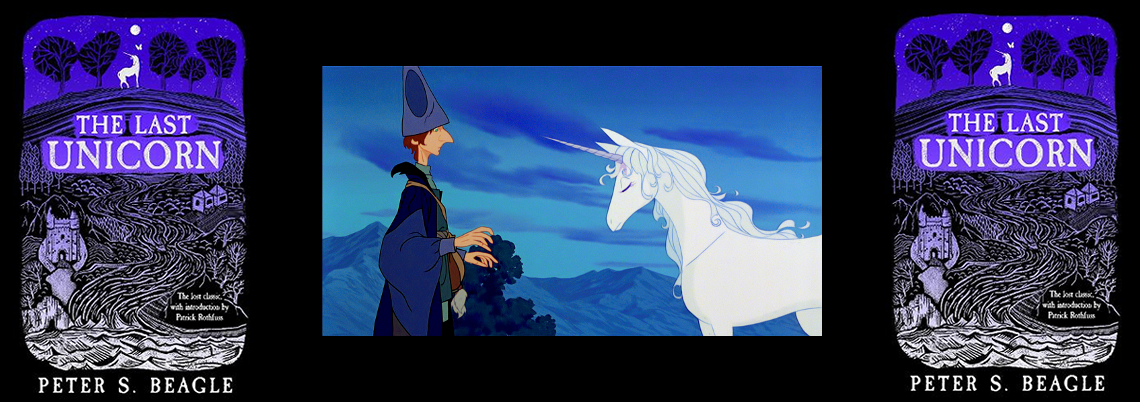
Some spoilers for The Last Unicorn throughout the review. Long read.
Co-writer for the blog, Argo, bought me the much-desired, limited edition, 2022 Gollancz copy of The Last Unicorn by Peter S. Beagle for Christmas, so I had to reread it.
Look at these beautiful blue edges. The silver ribbon bookmark. The decadent reflective detailing under the dustcover mimicking the light that the titular unicorn emanates. How could I not reread this?

Nice work on the promotional photography, Gollancz!
The pages are crisp and the font is decidedly large compared to many fantasy titles which cram their oversized tales into tiny, size-nine fonts and single-ply pages. As such, this copy of The Last Unicorn looks longer than it is.
In total, The Last Unicorn comes to 76,000-88,000 words, but it always takes me a laughably long time to read. The reader should never rush The Last Unicorn. Its sentences beg you to pause around them and admire their poetry. To rush through this story would be like turning yourself into the story’s antagonist, the Red Bull, trampling through the prose with nary a care for its beauty or elegance.

The Last Unicorn and Comparisons – Magic and Art
You could make tens of comparisons between the themes of this tale and various ideologies, but to do so dulls the magic of its beauty. The Last Unicorn is an ethereal book, and it feels more than a little unfaithful to drag its magic into the real world. Much like when the unicorn is hunted by the Red Bull, art can often seem silly when under the microscope:
‘She looked gaunt and small; and even Molly, who loved her, could not keep from seeing that a unicorn is an absurd animal when the shining has gone out of her.’ p.138

I am going to do so anyway. The magic within this book reminds me of how difficult it is to make beautiful art. Art is the unicorn—uncontrollable and untouchable by human hands, unless you’re Molly (pure of heart and unthinkingly honest).
I fear I’m a Schmendrick who hasn’t yet reached his apex. I struggle to bend my words to my will, and too often their intended effects go wildly astray. I’m frustrated and malcontent with anything less than brilliance. Like Schmendrick, it is often during my most hopeless moments that I feel the magic surge and produce something that feels close to what I hope for.
‘Then, swaying sick and beaten, he let his hopelessness march through him, until something woke somewhere that had wakened in him once before.’ p.141
I’m still hoping that one day I’ll wrest control of my own magic. If only I was as long-lived as Schmendrick…

The Last Unicorn and Comparisons – The Beauty of Female Autism?
I’ve been questioning recently whether I could be autistic, so it was on my mind during my re-read. It’s not an obvious or complete analogy, but I suspect there’s some merit to reading that The Last Unicorn ostensibly features a heroine who can be coded as autistic.
Unfortunately, doing so in this text largely serves only to beautify autism, which can cause complications for those who don’t thoroughly understand the difficulties of living with autism. As such, it is an analogy that I make very tentatively.
Since Wednesday’s 2022 debut on Netflix, autism in pop culture has been a hot topic. Communities are torn on whether to celebrate an autistic protagonist, or whether they should cry in outrage for the disservice done to what it truly means to be autistic.
Naturally, there’s a lot of division in what it truly means to be autistic since an individual’s experience is unique, and what may be true for half of the female autistic community may never be experienced by the rest. There’s also a lot of discomfort regarding Wednesday’s storyline becoming one of acceptance by the neurotypical community—something that seems like an unreachable star for many autistic people.
Like many stories seemingly about neurodivergents, Wednesday is on her own and fighting for her own survival, which is relatable, but perhaps not the best goal. By contrast, when reading The Last Unicorn as an autistic narrative, we have a story about a neurodivergent on a path to save her people at risk to herself.
There is no final desire to unite the unicorns, only to see them free again. Community and acceptance is—for once—not a prerequisite for a victorious ending. In this sense, The Last Unicorn is certainly a heroic dream for introverted types (a trait shared by many with autism). The driving force behind the narrative is that by freeing the unicorns, our heroine will not be the last. She will know that her ideologies and everything she stands for exists elsewhere and will not end with her.

The Last Unicorn and Comparisons – Masking Female Autism
In reading The Last Unicorn as an autistic narrative, one can learn a little about how it feels to mask one’s self—albeit in a very poetic form.
Around the people who love and respect her truly (Schmendrick and Molly), the unicorn is free to simply be the unicorn. The vast populace of humanity, by contrast, sees her as a plain old horse. A white mare. Unless told to expect her nature, most humans in the novel do not see her uniqueness, as much as many women experiencing autism often go unseen.
When amongst those who would control her for being a unicorn, she is required to mask. The unicorn becomes human, but despite how she looks, the inhabitants of King Haggard’s castle still recognise that there is something strange about the Lady Amalthea.
This suspicion reminds me of this study, Neurotypical Peers Less Willing to Interact with Autism (2017), which reported that while neurotypicals were unable to diagnose their peers as autistic, they did screen out autistic peers without really knowing why. Similarly, the Lady Amalthea is treated differently, though only her closest friends know the truth of her strange nature.
The longer the unicorn masks herself as the Lady Amalthea, the more she forgets what it was like to be the unicorn—to be unmasked. This, too, is true for many autistic women searching for late diagnoses. During the covid pandemic, many autistic women were allowed to become unicorns; to be themselves in the comfort of their own homes. Unsupervised and free, women realised how much energy is required to be ‘human’ in the real world, and that perhaps a world without unicorns isn’t an optimal ending.

Failures of Reading the Unicorn as Autistic
It is a very imperfect reading. For one, the unicorn claims immunity from feeling love and regret, which is not a quirk experienced by all, or even most, of any autistic community. Though asexuality is often tied to autistic traits in modern pop culture, this isn’t productive for the education of neurotypicals on what it is like to live with autism.
Similarly, following the unicorn’s stint as a human, she claims herself changed irreparably.
‘I am not like the others now, for no unicorn was ever born who could regret, but I do. I regret.’ (p.287)
I am uncertain what this could mean as an analogy to autism, except perhaps that extreme masking can cause deep trauma to the individual. The unicorn’s ability to regret isn’t seen as a wholly negative trait within the context of the book, however. Her new regrets are a broadening of her experience, though perhaps the same could be said for trauma.
Overall, I doubt The Last Unicorn was intended as an autistic narrative, and as such it should not be expected to fully conform. Instead, the onus is on the reader to tread carefully when making such analogies.
To Summarise The Last Unicorn
I love this book. I struggle to foresee a time in my life when I wouldn’t love this book. As I age, its characters shift in my hands. I always loved Molly, but did I ever pity her so much? When did I start to see myself in her ragged clothes? I’m only twenty-six years old, but I’m sure I’ll be thirty-eight like her in the blink of an eye. Perhaps one day, I’ll understand Haggard more than I’d ever hope to.
This book is more than you expect.
If you’ve read and loved The Last Unicorn, be sure to read The Two Hearts in Beagle’s collection of short stories, The Line Between, for a little extra content. You won’t be disappointed.
You may also be interested in reading my thoughts on introductions, inspired by Patrick Rothfuss’ Introduction to The Last Unicorn. You can read it here: A Beautiful Introduction. For more reading material that combines magic with art, I recommend checking out Elantris, and The Emperor’s Soul, both books by Brandon Sanderson.

 Beyond The Spine Reviews
4 Comments