
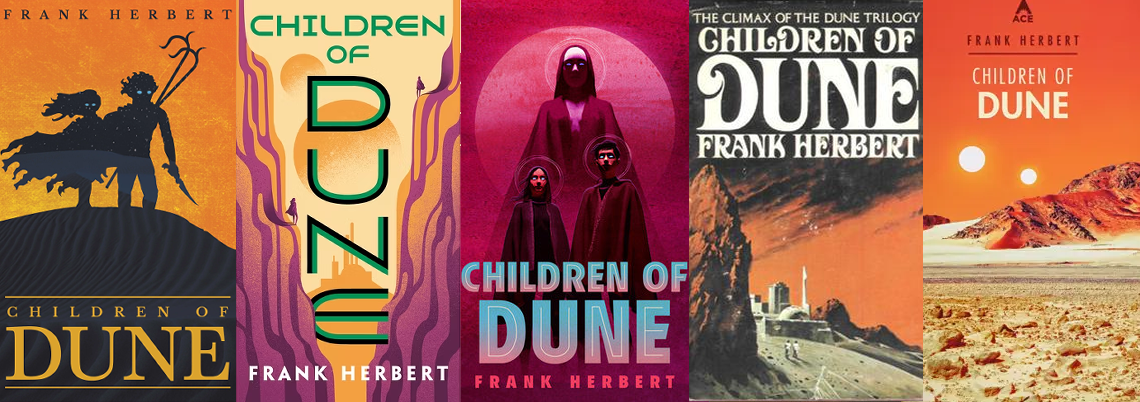
Long review. Major spoilers for Dune, Dune Messiah, and Children of Dune throughout.
Without a doubt, this is my least favourite addition to the Dune series so far. It’s more repetitive than Dune itself, and I found its protagonists harder to understand. I’m honestly unsure if I will continue to read the next book in the series, God Emperor of Dune, following my dislike of book three.

The Plot of Children of Dune
Where I would describe the preceding books’ plots as ‘complex’, I would sooner describe Children of Dune as messy.
Despite this, the novel can largely be summed up as a struggle for power and survival between a pair of Atreides twins and their troubled aunt.
Like Paul, the twins have the power of prescience—the ability to see a multitude of potential futures and the steps required to reach them. Like their aunt, they risk becoming overwhelmed by this information and sinking into insanity.
Through the twins’ aunt, Alia, the reader is shown one possible future for the twins—possession by one of their ancestors. Through the memory of Paul, we know that the only other escapes are complete loss of the self, or a literal death.
To avoid this, the twins Leto and Ghanima refuse to overdose on spice for as long as possible, as this will increase their prescient abilities and further endanger their sanity. Unfortunately, they are unable to retain their ability to choose as enemies draw closer.
Eventually, they conspire a plot to protect themselves, which leads to Leto being captured by a dangerous group of rebel Fremen, overdosing on spice, and turning himself into a sandworm to escape.
You read correctly; Leto attaches various baby sandworm to his skin to enable him to escape the rebels, return to the capital, and claim his rightful seat on the throne.
Because Leto doesn’t remove the sandtrout (baby sandworms), they begin to merge with his skin, and by the end of the novel Leto confesses that he is no longer human. The sandtrout have mixed with his organs, they live as a symbiotic being, and his life will continue for thousands of years.
And presumably, this creature is now the God Emperor of Dune, well-prepared for the titular sequel.

My Favourite Moments of Children of Dune
Amidst this rather messy plot, I did enjoy the twins originally.
In Dune, Paul was always alone to struggle with the immense burden and boredom of his prescience. The only person who came close to matching him was his mother, Jessica, and while their bond was undoubtedly formed from love, it was often tested—driving them apart for periods of time.
In Dune Messiah, Paul and Alia should have been closer, both possessing prescience to a similar degree. The two should have been able to confide in each other the way that Leto II and Ghanima do, but perhaps that is their mistake. In trying to avoid the incestuous desires of the Bene Gesserit breeding program, Paul and Alia stay somewhat removed from one another.
This perhaps leads to Alia’s breakdown in Children of Dune. Had Alia and Paul been closer, perhaps she would have been better able to cope with her powers. As things stand, she was unable.
By contrast, Ghanima and Leto II are very close, and they support one another by sharing their experiences. Unfortunately, this all comes to an end during the midpoint of the book when conspiracies converge to drive them apart—Ghanima is returned to Alia, and Leto II is captured by the people of Jacurutu.
And this is when I started losing interest in this hefty tome.
My Criticisms of Children of Dune
Upon the twins’ separation, Leto II begins his long trek across the bled, which is described in detail. Perhaps this is to give the effect of time passing as the reader’s life drains away, rereading sentences that are ground already covered in the first Dune title, and truthfully this latest voyage across the sand added very little to the series.
What follows next is Leto’s fascination with Sabiha, which is there to mimic the path taken by Paul and Chani in book one. Leto is tempted by visions of marital happiness, and I only know in retrospect that Leto chooses a different path to marriage.
In the moment, it simply feels like the series is retreading the same ground as the first book in trying to pair Leto and Sabiha. I had little faith that Herbert was going to turn around and choose a different direction for Leto, and as a consequence I was immensely bored during this section.
Just Girl Things
At the same time, the story seemed to have very little for Ghanima to do. We would occasionally flick back to her perspective where she is reduced to a passive creature, forced through plot hoops at the whims of her aunt. From this point, Ghani makes for a rather disappointing heroine.
Her new plotline fixates on marrying her off. It did not endear me to the book that while Leto overcame physical trials and espionage, Ghanima, Irulan, and Alia were busy discussing marriage. Their activities were all very neatly feminine, similar to Dune Messiah which focused on Irulan’s state as a concubine and Chani’s pregnancy.
Gone are the days when Chani murdered Paul’s aggressors on her own initiative.
Ghosts and Incest
Speaking of Paul, I enjoyed his tragic yet romantic ending in Dune Messiah, and was consequently peeved to see him rise from the grave in this book.
And speaking of hauntings, the question of incest has always lingered on the periphery of this series, but it finally comes to the forefront at the end of this book.
I’m not particularly bothered by incest in literature (having already studied Gothic literature at university), but I was frustrated by the book’s unexpected embrace of it at the very end. It shocked me that Leto would suddenly decide this after he and Ghani had semi-recently discussed how they would never engage in incest, and there seemed to be very little romantic attachment involved in that conversation. As such, Leto’s decision to claim his twin as his wife felt unearned. I don’t understand it.
I understand that Leto’s living still suit means that he will now live a rather asexual life, and that the reader shouldn’t expect any bedroom antics between the young twins. I also understand that Leto’s prescience and new understanding of the Bene Gesserit breeding program led him to take this path—marrying his sister but ‘bedding’ her with Farad’n. It’s the emotional side that is missing for me, and this is what frustrates me most about this plot.
Sandworms…?
And finally, I should say something about Leto becoming a sandworm, but what is there to say? I’m quite confused by it.

Summary
There’s a lot I didn’t like or understand about this book, but the return of Jessica was much enjoyed. I missed her greatly in Dune Messiah, and I hope she stays around for God Emperor of Dune! Only time will tell if I read it…
I’ve written a lot of sci-fi book reviews this year (2024), so I will be taking a break with my next read—Once Upon a Broken Heart by Stephanie Garber! It’s a return to solid fantasy and I’m looking forward to it!
Read my other Dune book reviews!


 Beyond The Spine Reviews
4 Comments