
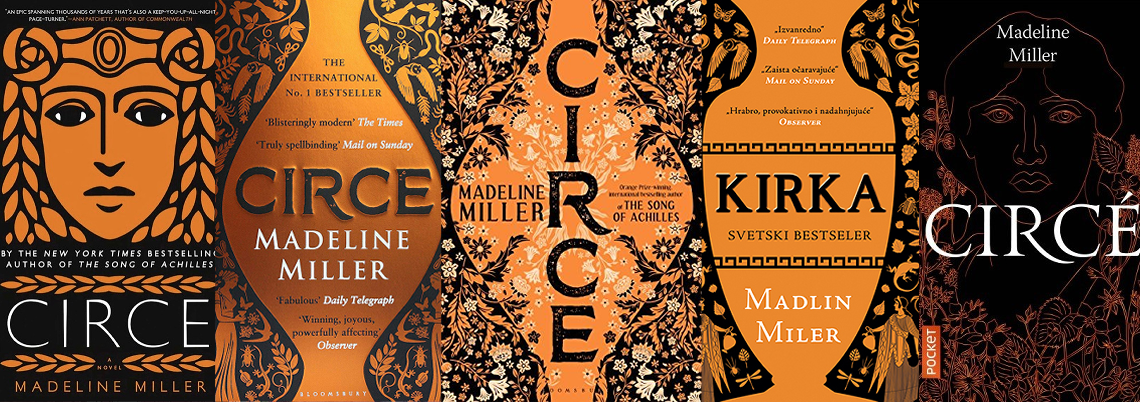
Spoiler intensity clearly marked below subtitles. Major spoilers throughout the review.
Ever since reading The Song of Achilles, Madeline Miller’s other Greek myth hit sensation, I have been immensely curious about Circe. TSOA was undoubtedly a book about men, and my hopes and expectations for Circe was that it would be a counterpoint focusing heavily on the female experience.
Onto that later, but first, my favourite moments of Circe.

The Best Moments of Circe
Major spoilers ahead.
I can’t talk about the best moments of Circe without first talking about Scylla, whose portrayal throughout was a monstrous delight. I didn’t know much about her original mythology before reading this book, which made it hit all the harder!
Since reading Circe, I also watched Netflix’s Kaos, and immediately locked onto the ‘Scylla’ branded soda in episode one—that’s how much this story appealed to me!

Second to Scylla, I also enjoyed reading about Circe’s initial sexual relations with Hermes. They were freeing and unimportant aside from the fact that they brought Circe pleasure—and that’s great to see. In particular, I think it was nice to read about Circe’s positive escape from virginity without melodrama or exaggeration.
Later in the plot, the easy relationship between these two sours, but I enjoyed its simplicity in the beginning.
Next, I’d like to talk about the representation of the titans in this book. Often, these Greek myth retellings are keen to focus on the glorious and golden Olympians, rarely do we see the perspectives of this strong but conquered people. I found it very refreshing.
There’s a lot to love in this book! Circe’s relationship with her animals really struck a chord with me. I enjoyed that these creatures who were so important to her really took up space in this book about her. Similarly, her witchery and magic were beautifully written—I tend to prefer magic systems that are more poetry than science, and this certainly scratched that itch.

Finally, I’d like to tip my proverbial hat to the foiling between Pasiphae and Helios. The reflections between those two character was unfortunately funny. I wish it could have been different, and that Circe could have had the sister she needed, but I can’t deny that I laughed at multiple points.
My Expectations of Circe
Major spoilers ahead.
Sometimes, I find that I don’t enjoy a book because it doesn’t meet the expectations I had for it. This was extremely true for Sanderson’s Frugal Wizard, which sorely disappointed me.

In Frugal Wizard’s case, I think the book was somewhat failed by its packaging—I got very hyped for various words in the title that resonate with me, that seemed not to be very true to the book itself. The main character is not much of a ‘frugal’ wizard, and he’s barely a wizard to begin with, and the whole concept of ‘Medieval England’ just missed its mark for me—as someone who studied Medieval English literature at university, I would know.
I don’t think a different title of blurb would have meant that I would have loved Frugal Wizard—it had other issues which you can read in my review—but I might have been a little less harsh on it had my expectations not started off so high.

Now, how does this relate to my experience with Circe?
Well, I read TSOA first, which is a beautiful book but it’s very androphilic, and at times also misogynistic—understandably given the culture and society it is trying to represent for the scene it wants to set.
Unfortunately, I got it into my head that perhaps Circe would be a more feminist counterpart—it isn’t. Circe struggles with a lot of internalised misogyny, which is beautifully drawn and easily traced back to her childhood experiences, but it isn’t why I picked up the book and that disappointed me.
It’s not Madeline Miller who has disappointed me here, it is myself for expecting something from this book that it was never intended to provide.
That said, I would still love to see this author write something about a character who doesn’t shy away from other women.
Before I leave this section to talk about the few criticisms I had of this book, I’d like to hang on the misogyny and androphilia in Miller’s most famous titles a little longer.
Women are used in this world, especially by men, which makes for an interesting read when Circe prioritises the company of men over the women in her life.
In the beginning, this is easier to understand as Circe’s female relations are cruel to her, but her later eschewing of the nymphs sent to her island tells us that there is a deeper trauma guiding her actions.
Her faith in men takes a dark turn when she blindly trusts the pirates who seek refuge on her island. Circe shoos away the nymphs and is alone when she is taken advantage of. I wonder if Miller was trying to make a particular point about Circe’s reactions to gender throughout the book.
My Criticisms of Circe
Major spoilers ahead.
Miller’s writing is beautiful, but if I’m being honest, the voice and telling of Circe honestly didn’t feel too different from Patroclus’ in TSOA.
Next, I’m not sure the end was totally fulfilling. It had been heavily signposting from the beginning—Circe had always had a deep curiosity about what would happen once she ate the pharmakeia—but I felt it was a bit of a cop-out not to show us. I wonder if Miller thought it would be more artful to leave the ending open.
Next up on my crit-list is a personal one that I’m sure will be some people’s favourite—but I really don’t enjoy pregnancy plots and Circe was no different for me! I can totally see how it is an important telling of motherhood and I’m sure many readers benefitted from reading about this perspective… but it didn’t add any satisfaction to my personal reading of this novel. It’s just not something that resonates with me, and that’s fine. It’s not a failing of the book.
Lastly, and this is a real criticism of the plotting, but the presence of the wayward nymphs sent to Circe’s island seems a little under thought at times. Circe sends them away while she’s birthing Telegonus, but then they’re mentioned again in an offhand line not much later. This feels like a mistake and made me question the scene I was in.
(I actually wasn’t sure if I’d missed a page where perhaps Miller explained the nymphs’ return, but I didn’t. Turns out my husband had the same experience during his read of the book. This feels like a genuine mistake in the writing that could have been fixed.)
Which Is Better, Circe or TSOA?
Can I answer this question…
Circe isn’t as dramatic as TSOA, but it’s also not a love story in the same way. Circe isn’t a romantic like Patroclus, and this book is far more of a character study of the narrator—unlike its predecessor, TSOA.
According to Goodreads, Circe rates 4.23, versus The Song of Achilles’ 4.32, making TSOA the public victor.
I’d rate this book a 4/5, which is the same as my rating for TSOA!
All in all, there’s not much in it. If you liked one, you would probably like the other!
Maybe, I’ll complete Miller’s most famous works by finally reading Galatea… until then, check out my booktok reviews and subscribe to the blog for future updates.

 Beyond The Spine Reviews
2 Comments