
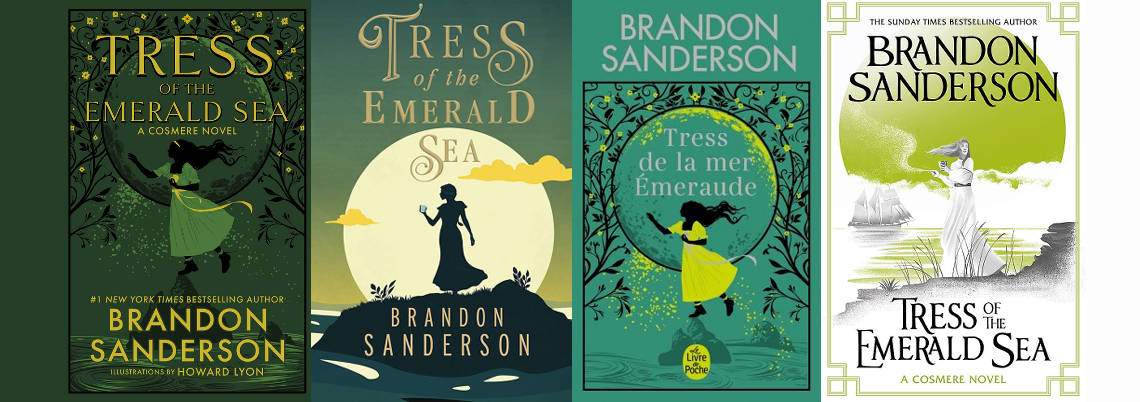
What if The Princess Bride and The Snow Queen had a book-baby? I think there’s a strong chance the result would look something like Tress of the Emerald Sea.
Simply put, I loved this book. It’s a clear departure from Sanderson’s usual style, but the fairy tale genre suits him well. The fast-pacing, the romantic plot, and the easy magic were utterly delicious.
Side note, I’ve been putting off Yumi and the Nightmare Painter for a while now because I’m less fond of the cosmere-heavy titles in Sanderson’s universe, but Tress is making me reconsider. If Yumi is anything at all like Tress, then surely there will be a lot for me to enjoy.

Tress of the Emerald Sea Synopsis
Mild spoilers for the opening chapters.
Tress, a young window-washer and her family’s breadwinner, has quietly fallen in love with the duke’s son, who returns her feelings. Their romance is about to take flight when, to everyone’s horror, the duke whisks his family away to marry the boy to a suitable princess.
When the duke returns home without his son, Tress knows that she must be the one to rescue her lover. What follows is a brilliantly spun tale of magic, longing, and pirates, on a mystical planet where the seas aren’t made of water.
General Thoughts on Tress of the Emerald Sea
Very mild spoilers for the plot direction in this section.
It combines the piquant narrative flair of The Princess Bride with the plot beats of well-known children’s fairy tale The Snow Queen.
Now, there are plenty of tales romanticising female heroines on a journey to save their male lovers (The Golden Compass, Mistborn, KPDH), but I think The Snow Queen is a particularly strong comparison text for Tress because both feature a magical journey away from a kind and loving family to battle a femme-fatale sorcereress with various opportunities to grow and amaze along the way.
Overall, I think this book is an ode to the joys of being needed and whole-heartedly giving in a manner that doesn’t lead to self-degradation or tragedy, but instead encourages almost impossible growth for the individual and the company they keep.
It’s the kind of story I need to hear more often.

When to Read Tress of the Emerald Sea – A Cosmere Novel
No spoilers in this section.
While Tress of the Emerald Sea is part of Sanderson’s cosmere universe canon, it is very tangential and can be read at any time.
There are some references to other worlds and magics within the narration, but even a seasoned traveller of the cosmere like me had trouble following all of them, and not because I haven’t read the related franchises, but more because I don’t devote my entire brain to cosmere facts. I cannot remember the specifics for the life of me.
As such, my brain glazed over Sanderson’s niche references, eager to be on with the rest of the story. If that sort of thing bothers you as much as it bothers me, then I can tell you that Tress has fewer grand references than other Cosmere novels, which made the multiverse aspect simultaneously more palatable and easier for me to ignore. Win-win.

Tress of the Emerald Sea, Word and Page Count
Page count is a silly metric, because depending on font size, you could have more or fewer words per page, and thus more or less reading to do than another book with the same page count.
For example:
| Tress Paperback | Tress Kickstarter Special Edition | |
| Page Count | 365 | 479 |
| Word Count | 107,227 | 107,227 |
Additionally, Tress was first released on January 1st, 2023. (Information for this section was sourced from the Coppermind Wiki).

That said, I do enjoy my annual page count challenge on The Storygraph app, but that’s mostly because it’s more consistent than an annual book challenge. If I could do a wordcount challenge, I would.
Spoilery Thoughts
Straight off the bat, Hoid as the narrator nearly caused me to put the book down. I vastly dislike insincere narrators and the jokey telling of Tress’ first chapter did not sit well with me. Fortunately, I stuck it out until meeting the lovable protagonists, settled into the story, and eventually, Hoid became a little more romantic as the plot progressed.
Despite the rocky first few pages, I quickly bought into the characters’ young romance. I actively enjoyed Tress’ gentle pining, and celebrated the support she received from her community.
It’s not too long in the tale before the talking rat appears, and despite the narrator’s confidence that talking rats are a feature of this world, I refused to allay my suspicions. I’m too big a fan of fairytales to not realise that the talking rat should contain more than first appearances, and I was consistently skeptical over Tress’ inability to properly question whether the rat was cursed.
It wasn’t until 50 pages before the finale that I confidently voiced aloud to peers who had already read this book that the rat was indeed Charlie. There was no longer enough room in the plot for that loose thread to wrap up in any other way, and I was happy for it to come true a few chapters later.
Communication Issues Trope
Like many romances, one of the principle issues that arises between Tress and Huck is a lack of communication. The kind where, as a reader, you’re banging your head against the nearest wall, lamenting that the two don’t just explain their feelings to one another instead of removing the other’s agency. In Tress, however, there is literally a curse to prevent Charlie/Huck from being honest about what is truly happening, so there’s a very comfortable loophole in a typically infuriating trope.

Silly Shenanigans
Tress doesn’t take itself too seriously. As I stated earlier, I don’t usually like this in my fiction, but like The Princess Bride, Tress‘s telling is so heartwarming that I can’t bring myself to dislike it.
Two parts that struck me as particularly silly and undermining include the name ‘Glorf’ and the description of the midnight rat.
By confessing the main character’s birth name as ‘Glorf’, romantically nicknamed as Tress, it feels as if the narrator is undermining the reader’s expectations for a romantasy heroine from the off. And yet, her nickname is totally befitting of the fairytale genre, whose female protagonists are often named for their features (Goldilocks, Snow White, Red Riding Hood). Simultaneously, the naming ‘glow-up’ also reminded me of Dirty Dancing (film).
Secondly, the description of the midnight rat was decidedly ‘low poly creature in a fantasy book’. I couldn’t help but snort at the image. It could have been played for spookiness, especially later in the book, but with the central message of the novel being about the vast potential one unlocks when they overcome fear, the silliness was a strong direction to lean into, much like how to defeat boggarts in Harry Potter.
Land Ahoy!
Sailing through a sea of shelves, searching for more pirate fiction? Look no further than my review of Robin Hobb’s The Magic Ship, book one in an epic fantasy series that was first published in 1998.
Coming up next on the blog, my long-awaited review of Under the Oak Tree (Book One) by Suji Kim, an inland story of knights and nobility.
Subscribe for email notifications containing my latest reviews:

 Beyond The Spine Reviews