
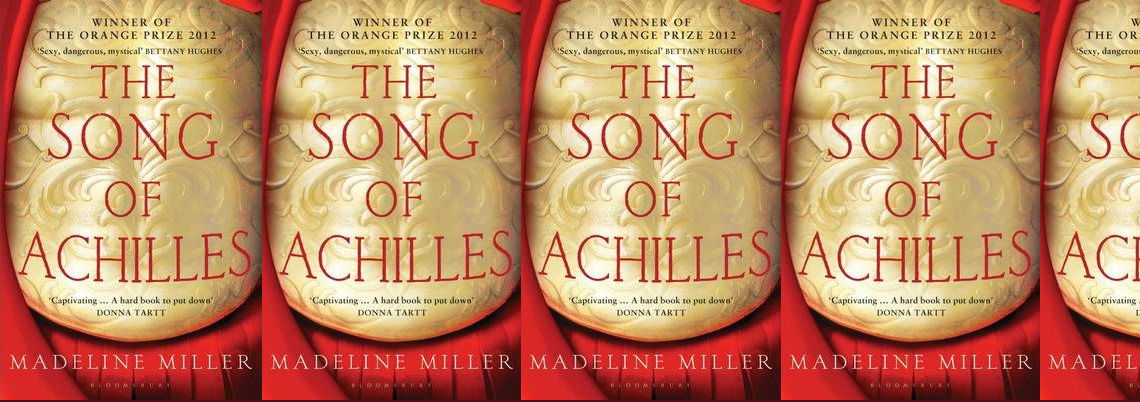
Long review, spoiler sections clearly marked under subtitles.
This was a truly beautiful book. While I was less taken with the final third, it will doubtless stay with me for many years to come.

The Song of Achilles Themes
No spoilers here!
The Song of Achilles by Madeline Miller follows the classical myths of Patroclus and Achilles, Greek heroes and close companions… or, by some interpretations, lovers.
The original myths surrounding these two figures differ on the details, and so the reader should not take Miller’s telling as a definitive story, because there is no definitive story. Some of the greatest myths and legends have thrived on the debates sparked by the differences in their retellings, as scholars and readers attempt to push their rhetoric as the winning one to be remembered through the ages.
For now, the myth of Achilles and Patroclus remains at an impasse—with many choosing to read it as a representation of Ancient queerness, where others still shout for a tale about good friends. Only time will tell if one reading can win out against the other.

Miller has certainly championed the reading of Achilles and Patroclus as lovers, and I celebrate the heart and detail with which she portrayed this. I will struggle to imagine the two as anything less than Miller’s image, as will many others, if the Goodreads numbers are anything to go by (over 1,300,000 reviews as of 01/01/2024!).
The heart of this novel is a troubled romance filled with family politics and sexual awakenings. While adequately rude for a romance novel, it was not graphic, and so I would consider it suitable for mature readers aged fifteen and over. However, due to Patroclus’ first person perspective on women, I would recommend that parents consider the maturity of their child before permitting them to read this, and to check their perspective on such matters during their experience.

Does Magic Exist in The Song of Achilles
This was one of my main questions while reading TSOA, and I do wonder how many other readers wondered this. Perhaps, if one is already familiar with Miller’s other Greek retellings, such as Circe and Galatea, then one would anticipate Miller’s perspective in TSOA. For me, however, I spent the first sixty-odd pages questioning whether the gods and nymphs were truly divine, or just peasants forced into narratives dreamed up by a lustful nobility.
It was not until the centaur Chiron entered the story at page sixty seven that I truly believed in Thetis, and Achilles’ divinity by association.
“I stared — at that impossible suture of horse and human, where smooth skin became a gleaming brown coat.” P. 67
As a fan of fantasy and magic, I was quite pleased to learn that the magic could be believed in. As a reader and writer, I wonder whether the quaint question of magic’s reality in fiction serves as an interesting mystery until proven, or as a distraction. I haven’t been able to come to a conclusion—perhaps the answer is a bit of both.
Romance in The Song of Achilles and LGBT
Major spoilers for the book ahead
Romance is certainly the heart of this book, as the reader hopefully intuited from its rather romantic title. Unfortunately for Patroclus and Achilles, romance is only half of it.
I went into this title mostly unaware of their story, other than a vague expectation of queer representation. I was blissfully unaware of their tragic ending. Now, I generally dislike tragedies, and to be truthful I’m still a little cross that these beautiful characters escaped a happy ending—I’m a very selfish reader—but I also felt that the ending was so masterfully signposted and built up that I can’t hate it for long. Besides, Miller was retelling their tale, and I’m not sure there is a version of Patroclus and Achilles that ends happily.
The love Patroclus has for Achilles is overwhelming, and I did in fact cry twice over the writing of it. Perhaps I saw my worst self in his jealous, lonely soul.

“I saw then how I had changed. I did not mind any more that I lost when we raced and I lost when we swam out to the rocks and I lost when we tossed spears or skipped stones. For who can be ashamed to lose to such beauty? It was enough to watch him win […]. It was enough.” P. 47
I particularly enjoyed how romance motivated the two lovers, but more than that, I loved the peace they experienced in their years spent on the mountain, away from ambition and responsibility. Until the final act, their joint goal was to be together, and I rejoiced in that.
Women and Bisexuality in The Song of Achilles
Major spoilers for TSOA ahead
Having read TSOA, I am very keen to pick up Miller’s more female-dominated titles to see the representation of women there.
The Song of Achilles is written in the first person, narrated by Patroclus himself, and contains his Ancient Greek and male perspective on the servitude of women. Patroclus is a proud man, and women can never be equals in his society; he seeks something else, something more. He seeks Achilles.
“I watched a boy fumbling at a girl’s dress, the dull look on her face as she poured his wine. I did not wish for such a thing.” P. 56
Where Achilles’ ambitions lie in fame and Godhood, Patroclus’ ambitions lie in Achilles—a forbidden love who touches divinity through his ancestry. Patroclus seeks a passionate romance, not something dull and easily taken. Not a woman.
In this sense, it is easy to read male-male relationships in The Song of Achilles as superior. Perhaps even as the ultimate, truest form of relationship. The women in his society are forced onto the fringes and thoroughly undermined in every way, and Patroclus reflects this with how he writes them onto the edges of his story.
Despite Patroclus’ early, formative experiences with women, he and Achilles later go on to have emotional and/or sexual encounters with Deidameira and Briseis. Largely, these women lack agency, which is frustrating—but that may be the point.
As one might imagine, the lack of female agency puts the brakes on this novel having much positive bisexual representation.
Patroclus’ experience with these women is always subpar to his time with Achilles—emotionally and physically—but I suspect that the story of Patroclus and Achilles is not the best place to search for a strong, positive bisexual narrative. Perhaps the culture painted within this narrative prevents it, but I couldn’t help but wish it had some of the bisexual strength of more nuanced bisexual narratives, that I read in 2023—Wolfsong and the Kyoshi duology.
Character Changes in the Final Third
Major spoilers for TSOA ending
The Song of Achilles is a tragedy, and, like many tragedies, Achilles’ downfall lies in his hubris. When Achilles reaches for Godhood, he accepts that he will be leaving Patroclus behind. To attain Godhood, sacrifices must be made, but the more sacrifices Achilles makes, the harder he grows, and the less familiar he becomes to the reader. By the end, it’s hard to align the boy who extended his hand to the traumatised Patroclus, with the murderer who consigns hundreds of men to death for his pride.
Achilles’ change is totally believable. He has never been especially interested in the lives of those beneath him, save for the few exceptions who break through his walls (Patroclus, Chiron, Peleus). His progression to an uncaring General should be expected, but is unfortunate nonetheless because it steers the story away from the sweet romance I loved it for.
Patroclus, of course, still sees and remembers the boy beneath the murderer, and loyally supports Achilles in all of his endeavours. For me, the reader, I too loved Achilles through Patroclus’ vision, and found Achilles’ growing distance from Patroclus’ narrative hard to bear.
To Summarise
The Song of Achilles is a beautiful book, and I love it best for its depiction of romance. I certainly hope to read Circe in 2024 after that wild ride!

 Beyond The Spine Reviews
2 Comments