
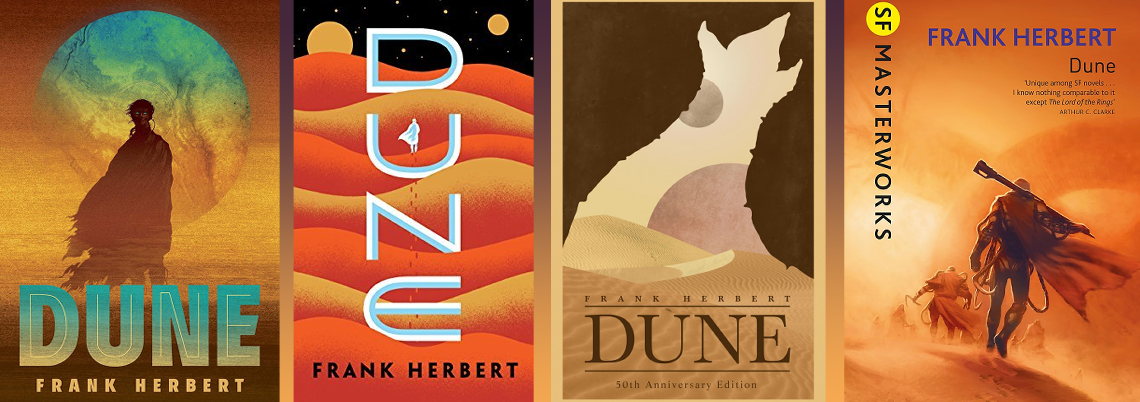
Long review, spoilered sections clearly marked below subtitles.
Dune… dry and vast. And yet, with pockets of luscious depth. Despite its reputation as a hard sci-fi book, I often found it difficult to remember that it wasn’t traditional fantasy. It has ‘lasguns’ and space ships, but its honestly more concerned with a magical space drug and religious prophecy.
I read books for their characters, and Dune’s author, Frank Herbert, was clearly very concerned with his characters’ depth and their curious relationships. If you too read for strong characters, I heartily recommend you give Dune a try.

You can also watch my short TikTok Dune book review, or scroll on to read an in-depth analysis of Dune’s themes and characters.
Arrakis, Dune, Desert Planet
Before jumping into the human characters of Dune, I want to write first about the character of Arrakis. Much like Mervyn Peake’s Gormenghast, where the sprawling, labyrinthian castle has a mood of its own, Arrakis too has a strong character.
Acrid and bitter, Arrakis is the enemy of all who live there. Its trials and tribulations are the first consideration of every new day. Arrakis itself appears indomitable, and its people strive to incorporate this ideology into their own cultures, whilst also trying to force the planet into submission.
And yet, Arrakis is not only fierce and testing; it’s also lonely. There are so few signs of life between the sand and the sky. A patch of grass here, a wandering Fremen or fugitive there… It creates a deep sense of longing for companionship. Arrakis, unmatched in its cruelty, hides any softness deep below its surface. Only in the sietches do we find community—and even those are threatened by the vicious customs necessitated by the extreme environment surrounding them.

Mother and Son
It feels apt that I would release this review around UK Mothers’ Day—close to the theatrical release of Dune Part 2—as one of Dune’s most unique aspects for me, as a fantasy reader, is the fact of its deuteragonists.
It is very unusual for a fantasy book to place such a strong focus on a mother-son bond. The most common family set-ups across my fantasy Goodreads tend to focus on orphans, run-aways, or father-son relationships—of which there are plenty (Stormlight Archive, Mistborn, The Saga of Darren Shan)

But a strong, positive relationship between mother and son feels very uncommon, especially one with such a balanced focus on the inner lives and desires of both mother and son. By comparison, Wolfsong also features an important mother-son bond, but the mother does not affect the plot nearly as much as her son. Gormenghast also features a prominent mother and son, but while Titus and Gertrude are both imposing characters, they remain distant from one another, as if they don’t know how they should act around one another.
By contrast, Dune’s Paul and Jessica feature a close relationship. They deeply care for one another and are alert to the slightest changes in the other’s mood—which is arguably unavoidable due to their magical heritage—but they also seek to ease one another’s pain when they can, and to further each other’s position in society. Even when separated, they act with the other’s survival in mind. They respect one another, even during personal disagreements.
I delighted in reading their successes, and how their care for one another could overcome the sexist and hostile environments surrounding them.
Fear Is the Mind Killer, and Shai Hulud
Minor spoilers for Dune book one.
One of the strongest images in Dune has to be the mighty sandworm. The majestic makers who are both life and death out on the sand.
They are an incredibly important image representing Paul and Jessica’s journey over the course of the book. In their first encounters, these mighty worms are terrifying and unfathomable, but by the end they’re well-understood tools that benefit their way of life.

These changed responses embody one of Dune’s most famous quotes: Fear is the mind killer. In the beginning, Paul and Jessica truly feared Arrakis, but overtime they succeeded in defeating their initial awe and becoming masters of Arrakis.
Aside from their direct relevance within the book, I also drew comparisons between the sandworms and the more traditional wyrms of English mythology. I’ve considered how the sandworms of Arrakis fill the more traditional role of a dragon in a standard fantasy setting, with our male hero striving to master the horror to assert his dominance over both the land and its people.
Feyd-Rautha and the Baron Harkonnen
Major spoilers for Dune book one.
The Harkonnens are a deeply fascinating clan and make for delicious villains. They’re written to be despised so the reader can take joy in their downfall. The Baron is the focus point of the Harkonnen factor and serves as a foil to Duke Leto, who is never quite replaced.
Where the Baron is worm-like—ambitious, excessive, and destructive—Duke Leto holds more in common with the Fremen: honourable, decisive, and a dreamer.
Truthfully, if there’s one common factor between all the characters of Dune, it’s that they all harbour grand ambitions.
Following Leto’s death, one might think that Paul would grow to become the Baron’s new foil, but this never comes to pass. Instead, the narrative posits that Paul must fight against his own Harkonnen heritage to find a middle ground that enables both ambition and survival. Instead, Paul’s foil is Feyd-Rautha, the Baron’s nephew and heir of the Harkonnen household.
He is the same age as Paul and destined to inherit, but the two couldn’t be more different. Where Feyd-Rautha leeches off his uncle’s power and cheats his way to victories, Paul grasps for honour and compassionate understanding. Where Feyd-Rautha’s inheritance is delayed, Paul’s comes too soon.
Curiously, Feyd-Rautha hardly has any ‘screen-time’ within the books. In total, there are perhaps two scenes where he is present—the arena fight and his demise against Paul’s crysknife. Instead, much of his character is conveyed through the internal monologues of the Baron. Considering his lacking presence in the plot, it seems a strength of Herbert’s writing and characterisation that Feyd-Rautha can be so quickly and easily positioned as Paul’s true foil.
Thoughts of Jesus and Dune’s Religion
Major spoilers for Dune book one.
There are many different interpretations of Dune, many talking about the clear Muslim heritage of much of Dune’s language. I come from a Christian background and, while I’m not always thinking about it, it strongly influenced my reading of this epic.
Perhaps I started making the connection because there are so few epic fantasy books like this one which celebrate the mother-son bond, that my mind jumped to the bond between the Mother Mary and Jesus Christ. Or perhaps it was the mention of the Orange Catholic bible which influences Paul at an early age. From there, I saw traces of the bible elsewhere in the text.
Paul is the young Messiah. Shai Hulud is the devilish snake. The water of life is the apple of knowledge. It’s an imperfect and unintentional reading, I’m sure, but it was on my mind, nonetheless. Especially at the book’s climax.
Near the end of the book, Paul is thrown into a sleep-like-death. He is taken into a cave in one of the sietches where Jessica does all she can to awaken him, to no avail. At last, she summons Chani, and by her side, Paul reawakens, and they leave the cave to meet the Fremen once more.
It bares some similarities to the final ascension of Jesus following his crucifixion. Jesus willingly goes to his death to shoulder the sins of humanity. He dies on the cross, is buried in a cave, and three days later he rises once more, with his mother and Mary Magdalene by his side. According to this bible, he is recorded to have said to his disciples, ‘All authority in heaven and on earth has been given to me.’
Is this not what has occurred to Paul, for drinking the forbidden water of life? For risking death for the salvation of the Fremen, to fully prove himself as the esteemed Kwisatz Haderach? His mind is fully opened, and not even The Guild who threaten his people from the heavens can control him anymore.
There is much about Dune that does not fit with a Christian reading, but I find the similarities that do exist very interesting.
Pacing of Dune
It wouldn’t be a Mel-review with some form of complaint or criticism! As much as I enjoyed Dune, sometimes, the pacing did just feel a little off. It was often difficult for me to understand how much time was passing between events, especially at the end of the book.
I think this is a quirk of Herbert’s personal interests in what he wanted to write about, which—kudos to him, it’s a long book and very successful. The greatest battles are largely glossed over, which I didn’t particularly mind, and the writing jumps about between characters and planets as it wants.
The Names of Dune
This isn’t so much a complaint as an observation, but the naming conventions of Dune employed by Frank Herbert were quite eclectic and often threw me out of the text a little. The Latinate-sounding ‘Atreides’ clan speared by Paul, Leto, and Jessica are foiled by the Germanic-sounding ‘Harkonnen’ tribe. The reverend mother’s name, Gaius Helen Mohiam, is adequately imperial and domineering. Then the Fremen have othered names such as Harah, Jamil, Stilgar, Liet, and Chani.
And then there are a couple of names that just seem extremely strange, even in the context of Dune. We have the enigmatic Fremen, ‘The Shadout Mapes’, and the incredibly American, ‘Duncan Idaho’.
I honestly don’t know what to think about these two. All I can say is that they don’t quite fit. So many of Herbert’s naming choices perfectly suit the characters that use them, and then there are these two! I’d just love to know his thought process for Duncan Idaho and Shadout Mapes.
Summary
I enjoyed Dune a lot! It took me a long time to read it, and I’m glad I had the film premiere of Dune Part 2 to motivate me to finish it, but I’m ultimately glad I read it and look forward to reading Dune Messiah sometime this year.
There’s so much I haven’t said about the Bene Gesserit, the use of prophecy, the book’s relationship with sensuality, and how much I love Chani, but maybe I’ll have more time for that in a review of Messiah, or maybe I’ll simply have to come back and write a second review of Dune book 1!
Next, however, I’m continuing my sci-fi book reviews with another Brandon Sanderson title: Skyward! See you then, maybe?

 Beyond The Spine Reviews
5 Comments