
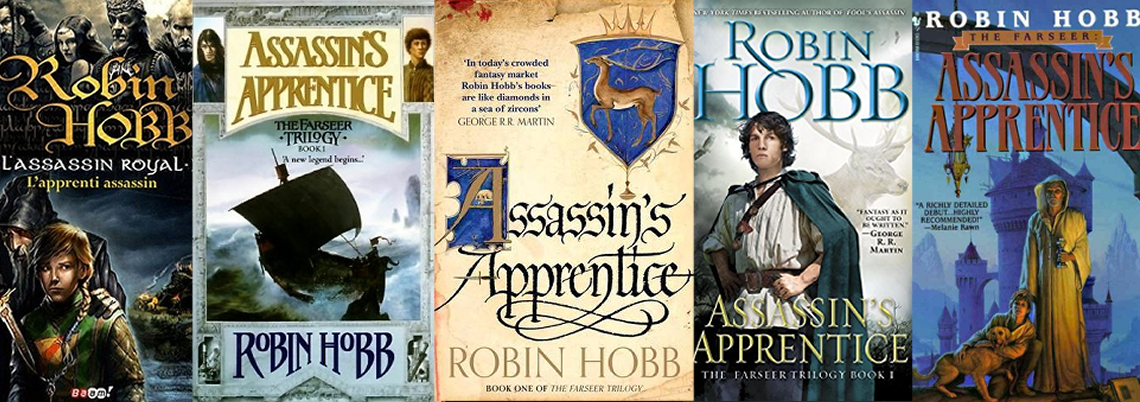
After successfully onboarding a colleague to Brandon Sanderson via Mistborn, she suggested I try Robin Hobb’s Farseer Trilogy. It’s a book I’ve had on my physical shelf for ages.
When I first moved to Switzerland, nearly five years ago now, Assassin’s Apprentice was one of the few books that I brought with me in the two suitcases that I wrapped my life into. It’s a little crazy that it took me so long to finally open the dusty 1996 paperback, but a little nudge from a new friend was all I needed to get started.
I don’t think my colleague guessed how much I would come to love this series.

Spoiler-free Summary of Assassin’s Apprentice
If you have specific questions, ask me in the comments!
The first novel of the The Farseer Trilogy sits firmly and comfortably in traditional fantasy trappings—including a map nestled in the first pages, very standard fare for the genre. The plot direction never really surprised me—which isn’t necessarily a bad thing, especially if one seeks a comforting read.
As much as I love House of Leaves, not every book has to be genre defying or boundary blurring!
Assassin’s Apprentice follows a young male of noble lineage, from his early childhood and into his teenage years as he is trained under a mysterious assassin… He makes friends, enemies, and a few amusing mistakes along the way. Don’t we all?
Aside from the main character, the book contains some great animal companions and a good chunk of magic.

If you’re a fan of ‘magic is a science’, where the magic follows a strict, learnable set of rules, such as which can be found in Brandon Sanderson’s works, then you should know not to expect that from the Assassin’s Apprentice. This book has some brilliant ideas, but the magic is more of an art, or an untamed beast, such as which is found in The Last Unicorn.
One way in which the Assassin’s Apprentice sits aside from many well-known, lauded traditional fantasy novel series (The Witcher, Game of Thrones) is that despite focusing on a male protagonist, it also features many interesting and active female characters who aren’t overly sexualised. Their stories are at least equally cared for in their telling.
One thing to note of this book is that while it is quite romantic in its telling, there isn’t much in the way of lasting romantic relationships. This isn’t good or bad, but it lends a certain melancholy loneliness to the text that will resonate with some people more than others.

Best Moments of Assassin’s Apprentice
It would be impossible for me to avoid mentioning the various dogs in this book, and I will soon be adding this title to my reading list for the best dogs in fiction!
Fitz’ relationship with Nosy is felt throughout the book, even when Nosy isn’t present, and the bond they share is deeply caring. Vixen is a tamer presence, but similarly beautiful.
The bond between a human and their dog is often recognised as one of the purest experiences a human can have, and this book truly understands that.
The brilliance of the hounds is partly due to Hobb’s skill with character depth and their relationships, which also extends to non-canine characters. Fitz’ curt but intense relationship with Burrich, his complex feelings towards his blood relationships, and the curious time he spends with his master and the fool are all grand examples of character.

Lastly, I’d like to add that the book’s finale was awfully exciting and masterfully done. It built on everything Fitz had endured and came together in a witty, theatrical finish that left me desperate for an encore.
(Thankfully, I didn’t have to wait long to read the sequel!)

Criticisms of Assassin’s Apprentice
This book was a 5/5 read for me, so my criticisms didn’t really impact on my enjoyment of this book. I think that’s worth bearing in mind when you read this section.
Assassin’s Apprentice doesn’t really hold much in the way of ‘plot’ as you might expect it. It plods along with insightful moments from Fitz’ youth with beautiful prose and empathetic voice. As a reader, I was fully taken in by this slow style as it’s perfect for building up a heavily detailed character portrait. In that sense, it’s a masterpiece.
The real sense of ‘plot’ doesn’t kick off until the final fifth of the book, when Fitz visits the mountain kingdom. Before then, there isn’t a clear overarching goal beyond Fitz’ survival and learning. There are some temporary goals locked within their moments, but it’s not the same as a standard fantasy where the end goal is established early and the reader works towards it the entire time. Examples of this I would mention include The Final Empire (rebel against God), Skyward (discover the truth about Dad and become the best pilot ever), The Last Unicorn (find the lost unicorns), Dune (restore the planet and try to be the next messiah).

Instead, Assassin’s Apprentice reminds me of Madeline Miller’s Circe, but Miller is also praised for her skill with defining characters through prose.
As a reader, I seek these intense connections with characters, so I have no issue with this style of telling. For some, however, I think this could be a challenge.
The Worlds of Robin Hobb
Lastly, I want to talk about multiverse fictions again!
If you know me or are an avid reader of this blog, then you have probably noticed that I am not a fan of multiverse fiction. It frustrates me to no end. Unfortunately, many of Hobb’s titles fall into the same ‘trap’. Air quotes because while I dislike the multiverse, it’s an attraction for many readers.
Luckily for me, The Farseer Trilogy is the first of five series set in The Realm of the Elderlings, and as of yet it bears no marks of the surrounding fictions—or if they are there, then I can’t see them!
As such, if you like a good multiverse, then you might like Hobb’s works. If you don’t like a multiverse, then The Farseer Trilogy still has my stamp of approval, but you will have to wait for future reviews to know if I say the same for Hobb’s later publications in this world!

A Farseer Trilogy TV Series?
This section includes spoilers for the final third.
Unfortunately, there is no news of any upcoming adaptations of The Assassin’s Apprentice into television or film.
There is, however, an ongoing translation of this magnificent tale into comic book form! The comic completed the story of Assassin’s Apprentice in July 2025, but a publication of the entirety of volume three will be released in December 2025 by Dark Horse comics, covering the novel from Fitz’ failure with Galen to the end of the novel.
Final Thoughts
I loved this book so much and could not wait to start reading it’s sequel, Royal Assassin. I look forward to sharing my review of book two with you very soon! Subscribe for a notification when I publish the review, or follow me on BlueSky at @melancholy3004.bsky.social.

 Beyond The Spine Reviews
2 Comments