
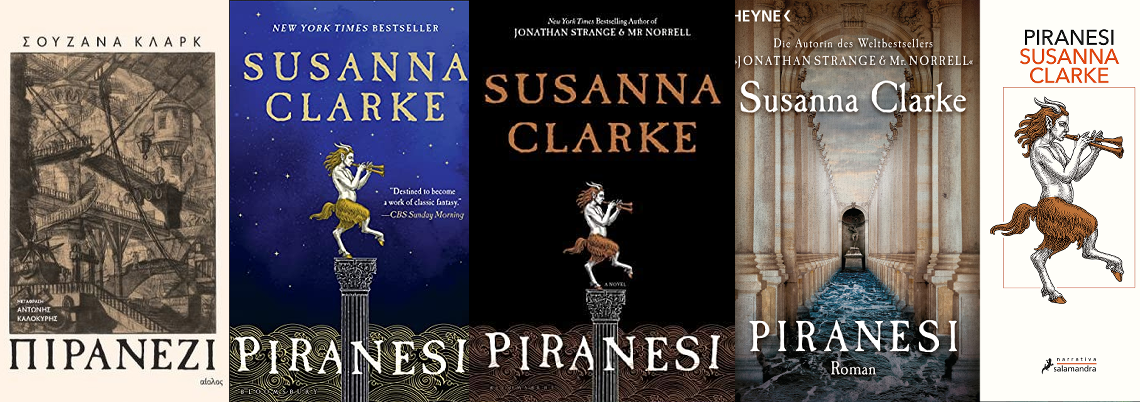
Literature rarely feels easily consumable, but Piranesi is certainly that.
I found Piranesi to be extremely satiating amidst an empty feast of romantasy flicks. I’ve already recommended it to a lot of people, and spent longer on this review than I usually do!
Fans of arty literature will certainly enjoy this book, and its brevity makes it a great starting point for beginners.
I documented my journey through the book’s seven parts below.

Piranesi Chapter Guide
Part 1 – Piranesi
From ‘the year of the Albatross’—commonly a symbol of death in literature—to the very literal skeletons that Piranesi ponders over, this book clearly has a fascination with death, and much like House of Leaves, the House reeks of limbo.
The particular obsession with the skeleton of a female child is disturbing, as Piranesi even dreams of the Faun Statue becoming real and interacting with it. Piranesi believes she should have grown up to be his wife; which has other uncomfortable undertones to it.
Within Piranesi’s frantic note-taking, I wonder if there’s a comment on the meaning of life itself. His determination to create interaction and dialogue, to pursue life and innovation in a place of stale death is curious.
In particular, the reference to 2011 and 2012 threw me. It has me questioning if the book will link back to a real-world event from those years, to make some grand artful comment, or if it will be the key to a traumatic moment in Piranesi’s life—the memories of which he’s surely ripped from his own journals in an attempt to become someone apart from them, even if that’s antithetical to his supposed current pursuit of knowledge.
Part 2 – The Other
Piranesi is almost disgustingly well-wishing and optimistic in this part. He avoids questioning the Other’s comparative wealth and contents himself with what the house provides.
That said, Piranesi’s joy is also enviable. The vibrancy with which he approaches life gives beauty to the narrative.
As Piranesi finds miscellaneous scraps of paper scattered about the halls of the house, I ask myself if they are from his own notebooks, forgotten by his own memory, or even from a sixteenth member of the House.
The references to the Minotaur once again remind me of House of Leaves, though I wonder whether Piranesi and the Other are truly the Minotaur and the servant, as referenced in the pages Piranesi finds in the Hall of Gulls.
Part 3 – The Prophet
It is implied that Piranesi was involved in some kind of accident that marred his once handsome features.
“This person showed me a photograph of you and since you were clearly a bit of a dish, I thought I would come and take a look at you. I’m glad I did. You must have been well worth looking at before, you know… before everything happened. Ah, well!”
p. 87
Is the Prophet Arne-Sayles? And could James Ritter be our Piranesi? Or the dishy Italian? I think it’s possible because Arne-Sayles commented on the handsomeness of Piranesi—which seems to be the Italian and Ritter’s most defining feature also.
However, it would be odd for a coherent narrator to write a biography of himself, in his own journals, not in first person. Similarly, I don’t think the timelines match up for Ritter and the Italien to be considered young in 2011-2012—when the journals begin.
Part 4 – 16
It is funny to me that Piranesi smells a lemon fragrance with no spice and continues to assume that 16 is a man. It makes me more certain that Piranesi is himself a man, which he initially claimed but I suspected until this moment.
The Other/ Ketterley confirms that The Prophet went to prison, which further suggests that The Prophet is indeed Arne-Sayles.
More text in this part confirms the Arne-Sayles and Prophet connection, but most interesting is the question 16 poses to Piranesi, ‘Are you Matthew Rose Sorenson?‘
This is a new name and has surprised me, as I expected Piranesi to bear a name already referenced in the plot.
Part 5 – Valentine Ketterly
It is confirmed on the first page of this part that the author of Piranesi’s journals is indeed Matthew Rose Sorenson.
Much of the interview recorded in this part reminded me of watching young Louis Theroux documentaries, which has cemented how I picture Piranesi in my mind’s eye.
Part 6 – The Wave
Raphael (16) is revealed, Ketterley drowns, and Piranesi is convinced to return to the ‘real’ world.
Overall, this section was more action-oriented, and didn’t leave me with as many ideas for arty interpretations.
Part 7 – Matthew Rose Sorenson
The final part shows the end of Piranesi, but it doesn’t offer the rebirth of Matthew, either.
Piranesi exits the labyrinth and is reborn as some new, unnamed entity, which I refer to as the narrator. The narrator lives in the ‘real world’, but he visits the labyrinth often enough, and Raphael makes a far better friend than Ketterley ever did.
My own question of whether the cycle of trauma continues—whether Piranesi would capture someone like Laurence Arne-Sayles and Ketterley before him—goes unanswered.
Additionally, the capitalisation of house-related nouns disappears into more standard English writing to show the narrator’s integration with society.
The Minotaur Analogy
For a long time, I thought this metaphor would become more integrated than it was. Arne-Sayles refers to Piranesi as having once been much more handsome (p.87), much like the Minotaur is known to be disfigured. I was a little surprised to reach the end of the book and discover Piranesi/Matthew/The Narrator was not particularly disfigured.
Further, both the Minotaur and Piranesi inhabit a labyrinth.
Both have a figure above them (King Minos/ Ketterley) who traps them in the labyrinth and has them killing trespassers.
Both stories have a female figure who navigates the labyrinth (Ariadne/ 16).
Unlike the Minotaur, however, Piranesi, the child of the labyrinth, is the victor.
Who Is ‘Piranesi’?
I consider myself fairly well versed in Greek mythology, which this novel most draws from, but I didn’t recognise the name ‘Piranesi’.
Following some Internet research, I discovered that Piranesi is a reference to an 18th century architect and illustrator. One of the real artist’s illustrations is used for one of the novel’s covers.
Beyond a shared interest in depicting labyrinths, the connection between the real Piranesi and the novel’s narrator ends there (to my knowledge).

Conclusion
I enjoyed Piranesi, but mostly it has left me with a deep hankering to reread House of Leaves.
Up next on this blog platform, however, is more romantasy! Subscribe for email notifications to alert you when the following reviews drop:
- Someone You Can Build a Nest In, John Wiswell
- Under the Oak Tree (The Novel) Volume Three, Suji Kim
- Ship of Destiny, Robin Hobb

 Beyond The Spine Reviews