
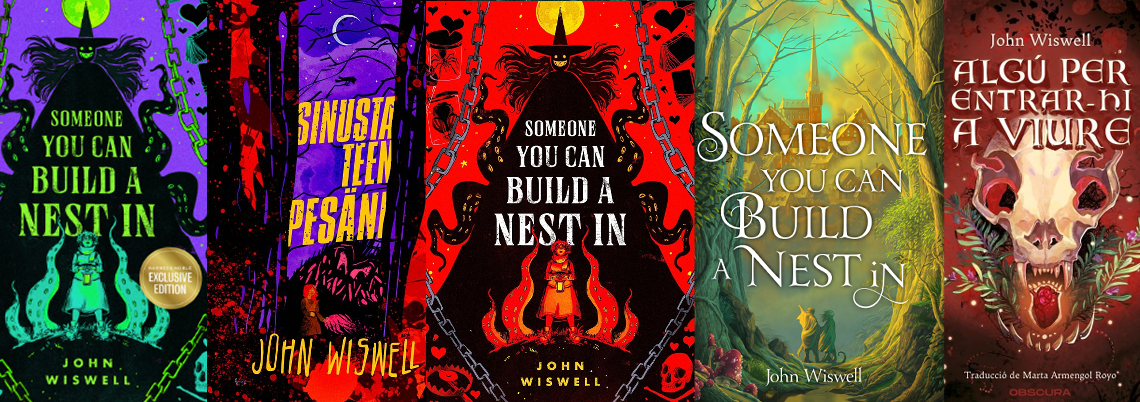
I don’t know where to start with reviewing this extraordinary debut novel from John Wiswell, so I’ll tell you primarily that this book is a 5/5 read.
Secondly, Someone You Can Build a Nest In is a long title, which I will henceforth abbreviate to SYCBANI.
Spoiler-free Summary
You could read the novel’s own blurb, but if you’re allergic to that idea and desire a differently curated summary, then keep reading!
Birthed in gore and quickly orphaned, Shesheshen is a rare breed of monster—believed to be a dragon by the local townspeople that she loves to terrorise.
In truth, Shesheshen is a homicidal slime girl who values her alone time almost as much as she values a full stomach, but could that be about to change?
SYCBANI is firstly a horror fantasy with a villainous protagonist, but there are early elements of queer romance that can’t be missed and should be enjoyed.
This is a very unique book, and so it is hard to think of texts to compare it with or judge it against, but if I absolutely had to compare it to my own library…
SYCBANI shares similarities with Andrzej Sapkowski’s The Last Wish (Witcher series) in terms of tone and fantasy, but it has a wild creativity closer to Sanderson’s Tress of the Emerald Sea, and a romance that reminds me of Mead Mishaps #3 but is truly a hundred cuts above.
Lastly, I’m a reader who struggles with gory descriptions, and for me, this book towed the right line between intrigue and disgust. In particular, I would praise this book for its creative descriptions that avoid lingering on painful elements—something which horror books can blindly exaggerate or even sexualise (Check out my disparaging review of Once by the horror novel giant, James Herbert.)
I would say that SYCBANI is suitable for young adults and older, but best not to gift it to anyone during exam time—it’s too excellent a distraction.
For those readers hunting spice (not the Dune kind), SYCBANI does not feature any sex scenes. You’re better off looking to the Mead Mishaps series if that’s your desire.

Favourite Moments in SYCBANI – Spoiler Section
It’s hard to pinpoint a singular moment, and I would instead highlight the endless twists that had me forever second guessing.
As a literature major, I’m usually pretty good at picking up on the subtext to decode a mystery early, but SYCBANI was so unusual that I couldn’t guess where it was going. In other books, this feeling has sometimes frustrated me because I have very little recognisable to hold onto or relate to as a reader (see my Murakami review)—I didn’t feel this way with SYCBANI, which employs plenty of familiar fantasy tropes (knights, dragons, damsels, and curses) but rearranges them in such a fresh display that I was perpetually left wondering, “what’s next!?”
Firstly, I want to talk about the incest subtext in this book, which threw me a loop.

Incest?
Discovering that the Baroness is Shesheshen’s creator was shocking, but worse, it means Shesheshen shares a mother with her lover.
It’s quickly explained that the Baroness murdered Homily’s parents and took over the role of her mother. Meanwhile, the Baroness created Shesheshen, but never really filled the role of a parent for her. Essentially, Shesheshen and Homily are not related, though their family politics are tied up together.
Aside from that, I’m not really clear on whether Epigram and Ode are really Homily’s blood relatives, or more stolen children from other families.
Motherhood
On that note, the reveal of the Baroness being a wyrm herself was spectacular; I did not anticipate it in the slightest, and I felt like an idiot for missing the twist. The motif of the hanging metal teeth was woven throughout the narrative, and I was totally swayed by Shesheshen’s belief that the Baroness had murdered her mother—in a way, I guess she had.
Motherhood is a real theme in this book. Shesheshen’s misplaced belief that had her mother lived, she would have been a good teacher, Homily’s misplaced trust in the changeling she believes is her blood relative, and Epilogue’s difficult but meaningful first year with her two mothers all tell very different (and important) stories.
The overarching theme is clearly that mothers have a huge impact on the lives of their children, whether through their presence or absence. It’s a lot of pressure for parents to withstand, which this book considers too!
Progressive
One of the standout features of this debut novel is how shamelessly progressive it is. From casually referencing the existence of enbies, to the lesbian romance at its core, not to mention how it doesn’t shy away from a an oversized love interest.
Additionally, readers who identify with autistic traits will likely feel represented by many of Shesheshen’s thoughts, feelings, and reactions. Arguably, this could be construed negatively (autistic people aren’t monstrous!), but that would be a gross misreading of the novel.
I think this book’s core message is that anyone can be a monster, neurotypical, human, or otherwise, but redemption can be found in unlikely places.

Epilogue
Both the creature and the feature. Few fantasy books are brave enough to provide a proper, emotional epilogue. Standard fantasy prefers to end on the climax of the main plot, rather than engage in any aftercare.
SYCBANI disagrees. Its epilogue is sweet, engaging, and thoroughly moved me. I left this book feeling satiated and comforted.
Other Books with Monstrous Protagonists
If you just finished SYCBANI and want more but don’t know where to turn—be glad! I love monster fiction! Check out my recommendations, or the complementary reviews if you’ve already read it.

The Last Unicorn, Peter S. Beagle
I want more mythical protagonists, less horror.
Featuring an intelligent but animal protagonist, The Last Unicorn follows the titular main character through a traditional fantasy world as she seeks the answer to whether she is truly the last of her kind.
This is a beautiful, short masterpiece that has touched the hearts of many, and will likely ring true for the readers who saw themselves in Shesheshen’s otherness.
Read my review of The Last Unicorn!

The Last Werewolf, Glen Duncan
I want more romance, more horror.
For readers who enjoyed SYCBANI but thought that the horror, human-eating, and self-hatred could have gone a few steps further, Glen Duncan’s The Last Werewolf trilogy could be the perfect follow-up read for you.
It’s worth warning fans of SYCBANI to brace for the harsh misogyny in the first book, but if you can ride it out, the sequels successfully turn that angle upside down.

Elantris, Brandon Sanderson
I want more magic and romance.
Featuring another monstrous protagonist in the undead noble Raoden, Elantris is a much slower, political read for fans of SYCBANI who enjoyed the otherness, but wished for more politics and magic.
Elantris doesn’t particularly go out of its way to be progressive, but I found the romance compelling enough. It also has its own elements of horror, but it’s simultaneously much more understated while also centered on pain and endurance.
This is currently a standalone novel, but Sanderson promises a sequel in future years.

The Wandering Unicorn, Manuel Mujica Lainez
I want more monstrous protagonists, more queer.
The Wandering Unicorn isn’t an easily consumable book, but it is a memorable telling of the myth of Melusine. Featuring a shapeshifting godling that questions gender identity and engages with queer themes, this book could be an interesting companion read to SYCBANI, if you have the patience.
Cirque du Freak, Darren Shan
I want the same level of horror, but less romance.
For similar levels of horror, people-eating, and readability, Darren Shan’s Saga Darren Shan series is a YA series that is very readable. It lacks the queer angles that I celebrate in SYCBANI, but it otherwise makes for a brilliant companion read and is one of my all-time favourite series.
Discover other horror book reviews from our horror genre section, or subscribe for email notifications when new reviews drop on the blog!

 Beyond The Spine Reviews