
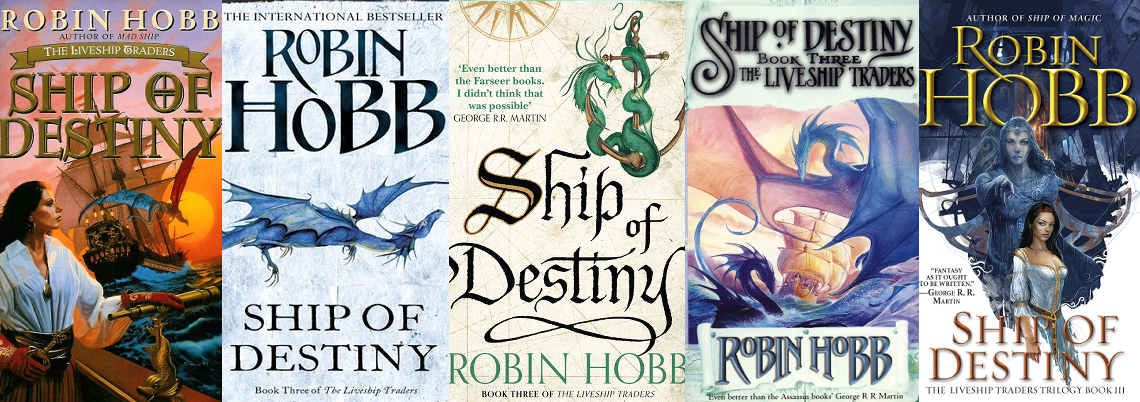
It’s the finale of Robin Hobb’s Ships trilogy, the second stage of the Realm of the Elderlings series! It’s been a wild ride full of transformation and death, and now is the time for reflection—book review time!
I’m a little sad to say goodbye to Althea, Wintrow, and Amber, but I’m sure that at least one of these characters will return in Hobb’s other books.
In this review, I’m particularly interested in discussing the characters of Kennit, Paragon, and Amber, but I also discuss our other favourites!
Heavy spoilers for Ship of Destiny from this point on, plus some references to character appearances from The Farseer trilogy.
Trigger warning for heavy spoilers and discussion of the sexual assault themes in this trilogy.

Kyle Haven – Was There An Alternate Ending Planned?
Don’t get me wrong, I’m a Kyle Haven-hater. I’m glad he died.
But…
I’m not entirely sold on the manner of his death, and, judging by a quick internet search, I’m not the only one questioning it.
It strikes me as odd that approximately two of the mighty tomes in this series were spent fretting about the confirmation of Kyle’s death (while the reader knows he’s likely alive), only to have him survive in the background until the last moment, and to then avoid most of the follow-up.
In Ship of Destiny’s conclusion, Kyle is unceremoniously killed by an arrow from a Chalcedean ship. He’s mere meters away from being reunited with his children—for better or for worse. Althea sees it happen, and she mostly feels torn about whether to tell Wintrow and Malta (she chooses not to).
Malta, who has spent the entire trilogy chasing her father, and believing she’s the only one can save him, never truly learns how terrible he was—though he dies so close to their reunions.
Wintrow, who is responsible for his father’s imprisonment, never faces the consequences of his request. It would have been an interesting moment for the priest-pirate.
Keffria, who spent so much of her life in the shadows of stronger personalities, delays mourning him, wonders constantly, and is never confronted by his return. I would have liked to see her stand up for the woman she became without him.
Overall, I’m just disappointed. When Brashen picked Kyle up from Key Island, I gained hope that some of these plots would be resolved. It’s not about seeking a better end for Kyle, it’s about wanting to a conclusion on how his actions affected the characters whose lives he challenged through his life and passing.
It makes me wonder whether Hobb had planned more, but it was cut at the last moment. Maybe for printing costs and page count, maybe for reaching deadlines. Maybe an editor put a limit on the amount of epilogue for a trilogy like this. I’d love to know more, but an internet search has turned up nothing, and I’m too shy to reach out to the author directly.
Althea & Vivacia
Althea finally gains passage aboard the Vivacia, only to have a terrible time.
It’s good to finally see the end of her trials to board Vivacia, but it doesn’t go how any of us expected, I think.
Firstly, Althea is forced to realise that things have changed. Opportunities have passed, and she’ll never regain the bond she remembers with the ship. Vivacia is now an independent soul, and both have experienced horrors that have changed them, and even put distance between them.
The rape incident is the core divide between the two. It’s extremely cruel that the moment at which Vivacia gains complete independence means that she fails to get the truth of what happened to Althea. Kennit’s transgression will be forgotten by history, though the consequences are Althea’s reality.
Vivacia’s distrust of Althea’s statement puts an irreparable divide between the two, and while Althea understands why Vivacia doubts her, their relationship will never be the same again.
Later, Paragon magically offloads Althea’s mental pain from the incident. Althea has suffered sexual assault before, and has somewhat overcome it. Kennit’s transgression is more horrific because of the drugging, isolation, brutality, and her relationship with Brashen—which makes it harder for her to convince herself that she might have wanted it.
Weeks pass and Althea is still tormented by the event, until Paragon takes away her pain. Althea never really overcomes it herself, and I can’t deny the allure of a fantasy where such trauma can be lessened by a magical device. Still, something about it feels problematic. If not for the character of Serilla, it might suggest that such memories are impossible to grow away from without divine intervention.
Overall, I think I would have preferred to see her take the truth to Brashen before receiving Paragon’s aid. I think that might have served a more conclusive, satisfying end to the narrative on Althea and her sexuality.

Paragon’s Face
While we’re on the topic of Paragon… What do you mean Paragon is now shaped like Fitz!?
It was the broken nose that gave it away for me, but this was quickly followed by the ‘warrior’s tail’ hair-do, a single earring that Amber specified must be silver and blue (like the one gifted to Fitz by Burrich), and an axe which Amber later engraves with the Buckkeep sigil; two stags fighting.
This is a very silly development, and I honestly don’t know what to think about it. I think I’m bemused?
Other than Paragon’s face, there’s Paragon’s behaviour, which all comes together in this final book. It’s another magical solution to mental illness, but it was finally time that Paragon finally felt confident in his sense of self.
Amber & Genderqueerness
This is the section that’s delaying my publishing this review. It’s taking me forever to write.
One of the themes I have routinely loved about the Realm of the Elderlings is the recurring presence of gender queerness, and I felt that theme was quite absent from Ship of Destiny.
This further confused me when I realised that Amber is in fact the Fool from the Farseer trilogy.
In the Farseer trilogy, the Fool is a brilliantly confusing character. By the end of that first trilogy, I was still unsure whether Fool was male, female, or neither, but in the Ships trilogy, Amber/Fool is unquestionably female. Kennit even goes so far as to describe her as a ‘golden goddess’!
It isn’t really a critique of the texts that this theme is lost in book three—it’s not as if the book sells itself on genderqueerness—but I missed it, nonetheless.
The realisation left me with plentiful questions about Fool/Amber, too: Why is she changing colour, and is she physically changing form? What gender is fool really? Should I have recognised Jek, too?
Honestly, I was happier when I wasn’t questioning whether Amber was Fool, and I’m kinda glad I missed it for so long. This feeling of confusion and instability is one of the reasons I try to avoid multiverse book series.
Malta and Reyn
It was hard (yet amusing) to read 900 pages of the two members of this couple individually thinking they were too ugly to be loved by the other, meanwhile, everyone around them regularly comments on their attractiveness.
Aside from being confusingly hot, these two also became the new Elderlings at the end of the novel, though it’s unclear what that status really means at this point.
The funniest moment of their tale had to be their smooching on the bloodied, corpse-heavy deck, while Althea worried about their safety.
There was also an analogue between Malta, Serilla, and the rest of the Satrap’s companions. What enabled Malta to truly succeed where others fell short was her combination of education, wits, confidence, and charisma. She understood the power of cultivating a status, and was not so proud to refuse a little debasement for more conclusive manipulation.
Malta’s scrabble for survival against all odds was truly inspiring—not words I expected to write about a character that I utterly detested for nearly 2000 pages.
In the end, I was glad to see her get a happy ending.

Tintaglia
The dragon was a strange but compelling beast in this narrative, and while the reduced focus on her ensures an element of mystery, I would still have liked to have more of an epilogue for this character. I wanted to know a little more of her plans after successfully restoring her race. Perhaps more specifically, I wanted to know how she regarded humans in that aftermath.
Perhaps this will be covered in the other books in the Realm of the Elderlings series.
Kennit
Captain Kennit was a despicable character, but ultimately pitiable. Preceding his surprisingly honourable death, protecting the Satrap, Kennit’s backstory is revealed.
I’m not surprised that Kennit was subjected to such horrors at Igrot’s behest, but I am a little confused by the love, compassion, and patience shown to him by the text’s narration and its characters (all bar Althea).
In my opinion, Kennit’s downfall might now be understandable, but his final actions remain inexcusable and abhorrent. Perhaps this section of my review is more a comment on the limits of my understanding and empathy than it is about the text itself.
Brashen
To end the text, Brashen fulfils the potential that Althea’s father imagined for him—Captain of a Liveship and free from addiction.
I thoroughly enjoyed Brashen’s romance with Althea, even if I struggled to understand why she wouldn’t choose Grag Tenira!
It’s a fitting end to the trilogy that these two lovebirds would be the ones to find and profit off Igrot’s mythical hoard.
Conclusion
To conclude, the Liveship Traders series has been a wild ride! Slow in parts, but thoroughly magical! I look forward to continuing my journey through the Realm of the Elderlings next year, with reviews to come on the Fool trilogy/quadrilogy in 2027!
Next up, a bit of Canadian literature followed by a return to the Women of the Otherworld series with book six by Kelley Armstrong.


